
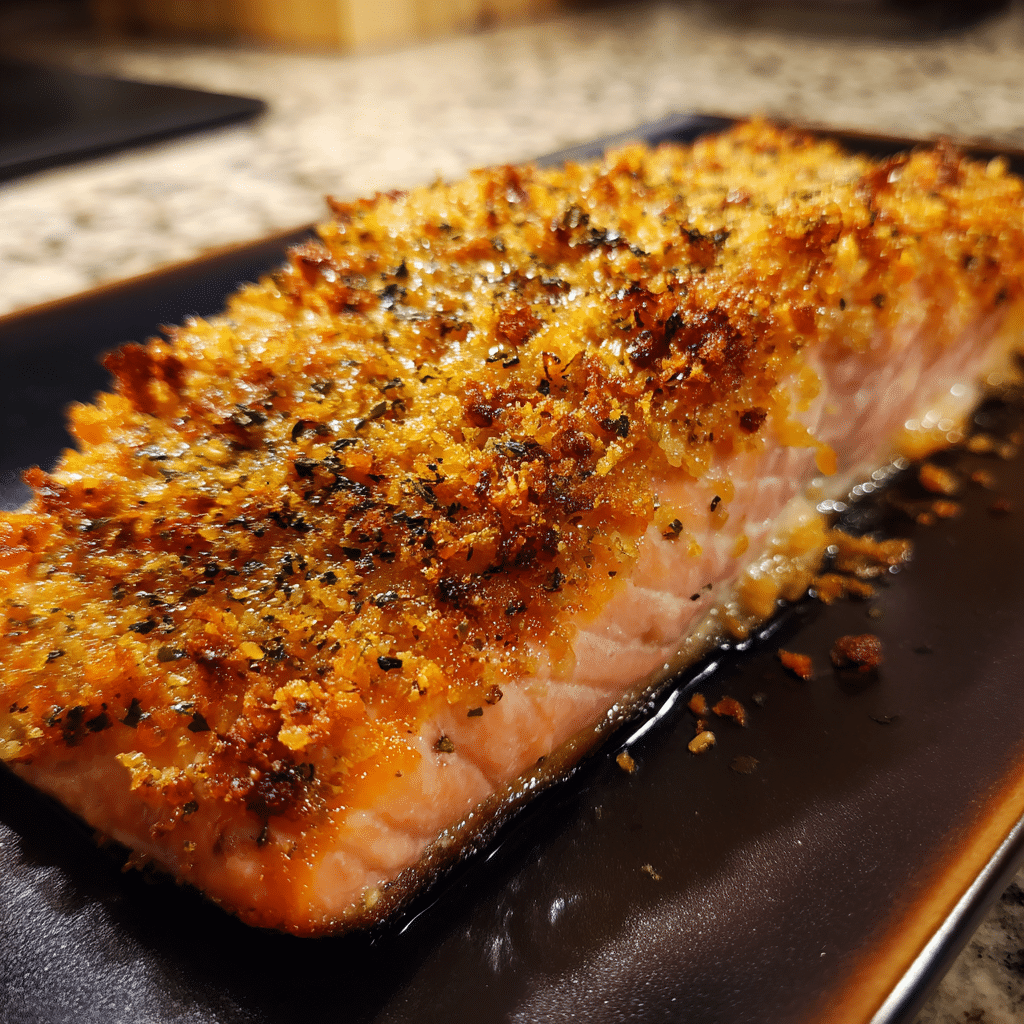
Tired of salmon that’s either overcooked and dry as cardboard or undercooked with that unpleasant translucent center? You’re about to discover a foolproof Crusted Baked Salmon technique that delivers perfectly flaky, moist fish topped with a golden, fragrant herb crust that stays crispy even after it comes out of the oven. This elegant recipe looks restaurant-worthy but takes just 25 minutes from start to finish.
Hi there, I’m Simon, and this Crusted Baked Salmon was born from a minor kitchen disaster that turned into our most-requested seafood recipe. Jackson Reed, our grill master, was preparing salmon for a dinner party when our outdoor grill refused to light. With guests arriving in 30 minutes, Megan Carter, my pastry genius, suggested we pivot to the oven and create a textured crust to compensate for missing grill marks. Olivia Brooks quickly mixed fresh herbs with panko breadcrumbs, and we pressed it onto the salmon fillets. The result was so spectacularly good that we’ve never gone back to grilling salmon. After testing fourteen herb combinations (ask Jackson about the “dill overload incident”), we perfected this version that’s elegant enough for special occasions yet simple enough for Tuesday nights.
In this complete guide, you’ll discover how to select the freshest salmon with ideal fat content, learn the secret ratio for crispy-stays-crispy herb crust, master precise oven temperatures that prevent drying, and explore global flavor variations that keep this healthy dinner exciting week after week.
Why This Crusted Baked Salmon Recipe Works
This Crusted Baked Salmon delivers exceptional results with remarkable simplicity:
- Foolproof Doneness: Oven baking at the correct temperature prevents the overcooking that happens so easily with stovetop methods
- Restaurant-Quality Crust: The panko-herb mixture creates golden, crispy texture that contrasts beautifully with tender salmon
- Quick Weeknight Friendly: From prep to plate in just 25 minutes, making healthy eating accessible on busy evenings
- Impressive Presentation: Looks like you spent hours in the kitchen, perfect for entertaining guests or special family dinners
- Nutritional Powerhouse: Packed with omega-3 fatty acids, high-quality protein, and antioxidant-rich herbs
- Minimal Cleanup: One baking sheet does all the work, reducing post-dinner cleanup stress
Choosing the Right Salmon for Crusted Baked Salmon
Best Salmon Types for This Recipe
The foundation of exceptional Crusted Baked Salmon lies in selecting quality fish with proper fat content. Wild-caught King salmon (Chinook) ranks as the richest option with highest fat content, staying incredibly moist under the herb crust. Sockeye salmon offers deep red color and robust flavor with firm texture that holds up beautifully to baking. Coho salmon provides medium fat content and milder taste, perfect for those new to salmon. Atlantic farmed salmon works well with consistent availability and affordable price point, though flavor is less complex than wild varieties. Avoid thin tail pieces which overcook quickly, instead choosing center-cut fillets of uniform thickness.
Buying Tips for Fresh Salmon
Look for these quality indicators when shopping:
- Firm, Springy Flesh: Press gently, fish should bounce back immediately, not leave an indentation
- Bright Color: Wild salmon ranges from deep red to pale pink, farmed salmon is typically bright orange-pink
- Ocean-Fresh Smell: Should smell like clean ocean water, never fishy, sour, or ammonia-like
- Moist Surface: Flesh should look moist but not slimy or sitting in excess liquid
- Skin Quality: If skin-on, look for shiny, metallic scales without dullness or discoloration
- Ask Questions: Request to smell the fish, ask when it arrived, and choose day-boat caught when possible
Salmon Substitutions
- Arctic Char: Similar to salmon with slightly milder flavor and gorgeous pink color
- Steelhead Trout: Often called “salmon trout,” offers nearly identical texture and cooking properties
- Rainbow Trout: Smaller fillets require reduced cooking time but work beautifully with herb crust
- Halibut: Substitute for white fish lovers, increase cooking time by 3-4 minutes
- Cod or Haddock: Flaky white fish alternatives, adjust cooking time based on thickness
Ingredients & Prep for Crusted Baked Salmon
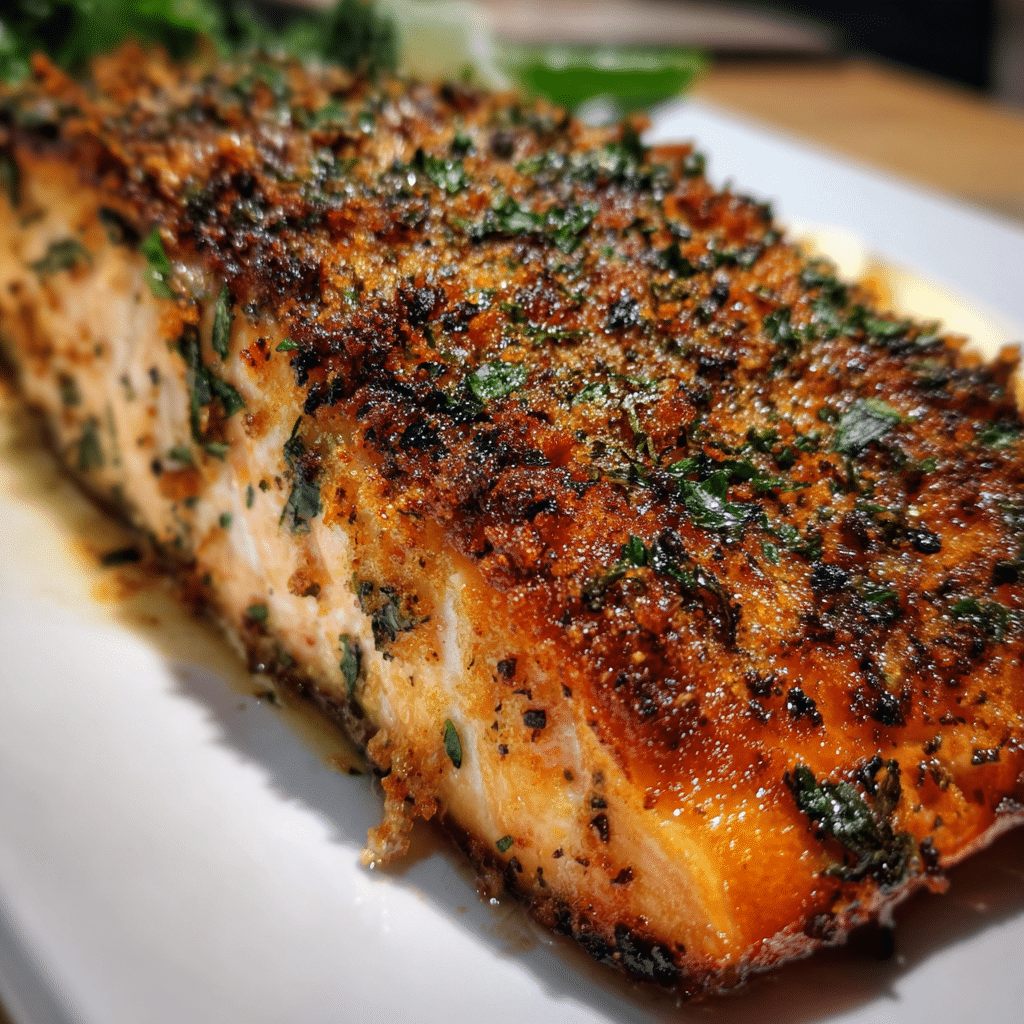
Salmon Preparation Essentials
Proper preparation ensures your Crusted Baked Salmon achieves restaurant-quality results:
- Pat Completely Dry: Use paper towels to remove all surface moisture, this is critical for crust adhesion
- Check for Bones: Run fingers along the flesh, remove any pin bones with tweezers or needle-nose pliers
- Room Temperature: Let salmon sit out for 15 minutes before cooking for more even heat distribution
- Portion Size: Cut into 6-ounce portions if working with a large fillet for consistent cooking
Crusted Baked Salmon Ingredients
For the Salmon:
- 4 salmon fillets (6 oz each), skin-on or skinless
- 1 tablespoon olive oil
- 1/2 teaspoon salt
- 1/4 teaspoon black pepper
- 1 tablespoon Dijon mustard (helps crust adhere)
For the Herb Crust:
- 1 cup panko breadcrumbs
- 1/4 cup fresh parsley, finely chopped
- 2 tablespoons fresh dill, finely chopped
- 1 tablespoon fresh thyme leaves
- 1 tablespoon fresh chives, minced
- 3 cloves garlic, minced or grated
- Zest of 1 lemon
- 3 tablespoons melted butter or olive oil
- 1/4 teaspoon salt
- 1/4 teaspoon black pepper
- 2 tablespoons grated Parmesan cheese (optional)
For Serving:
- Lemon wedges
- Fresh herbs for garnish
- Optional: Lemon butter sauce or tartar sauce
Pantry Staples
Keep these essentials on hand for quick salmon dinners:
- Breadcrumbs: Panko for crunch, regular for finer texture
- Fresh Herbs: Parsley, dill, thyme, basil, cilantro
- Citrus: Lemons and limes for brightness and acidity
- Quality Oils: Extra virgin olive oil, butter for richness
- Mustard: Dijon acts as glue for herb crust and adds flavor depth
Step-by-Step Instructions for Crusted Baked Salmon
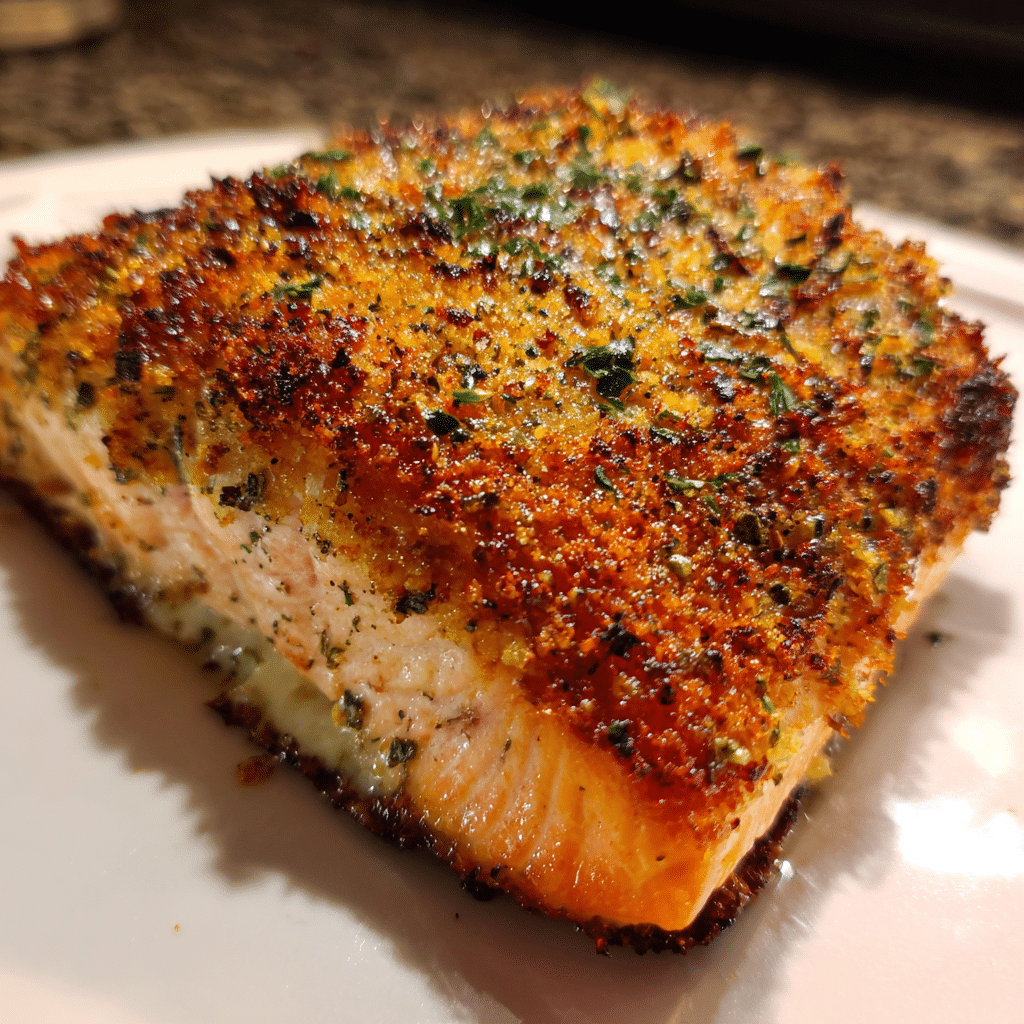
Pre-Baking Prep for Crusted Baked Salmon
- Preheat Oven: Set oven to 400°F and position rack in upper third for optimal browning
- Prepare Baking Sheet: Line a rimmed baking sheet with parchment paper or lightly oil with cooking spray
- Check Salmon: Remove any pin bones with tweezers, pat fillets completely dry with paper towels
- Season Base: Brush each fillet with olive oil, season with salt and pepper on both sides
- Spread Mustard: Apply a thin layer of Dijon mustard on top of each fillet where crust will go
Baking Method for Crusted Baked Salmon
- Make Herb Crust: In a medium bowl, combine panko breadcrumbs, chopped parsley, dill, thyme, chives, minced garlic, lemon zest, salt, pepper, and Parmesan if using
- Add Butter: Pour melted butter or olive oil over the breadcrumb mixture, tossing with a fork until evenly moistened and mixture holds together when pressed
- Apply Crust: Divide herb mixture evenly among the four salmon fillets, pressing firmly onto the mustard-coated tops to create an even layer
- Arrange on Sheet: Place crusted salmon fillets on prepared baking sheet, spacing them 2 inches apart for air circulation
- Bake: Place in preheated 400°F oven and bake for 12-15 minutes depending on thickness, without opening the door
- Optional Broil: For extra-crispy crust, broil on high for the final 1-2 minutes, watching carefully to prevent burning
Doneness Check for Crusted Baked Salmon
Perfect Crusted Baked Salmon should meet these indicators:
- Internal Temperature: 125-130°F for medium-rare (translucent center), 135-140°F for medium (slightly opaque center), 145°F for well-done per FDA
- Visual Cues: Flesh should be opaque and flake easily when tested with a fork, crust should be golden brown
- Touch Test: Gently press the center, it should feel firm but still have slight give, not mushy or hard
- Color Check: Wild salmon remains deep pink-red, farmed salmon turns lighter pink-orange when cooked
Resting for Crusted Baked Salmon
Unlike beef or chicken, salmon requires minimal resting time. Let the Crusted Baked Salmon rest for just 2-3 minutes after removing from the oven. This brief rest allows juices to redistribute and the temperature to carry over an additional 5 degrees, bringing medium-rare to perfect medium doneness. The herb crust sets during this time, becoming even crispier. Serve immediately while the crust maintains maximum crunch and the salmon stays warm and succulent.
Pro Tips for Perfect Crusted Baked Salmon
Avoiding Dry or Overcooked Crusted Baked Salmon
- Don’t Overbake: Salmon continues cooking after removal from oven, take it out when slightly underdone
- Uniform Thickness: Choose fillets of equal thickness or fold thin tail sections under for even cooking
- Watch Temperature: Invest in an instant-read thermometer, it’s the only reliable way to judge doneness
- Avoid Direct Heat: Position rack in upper third of oven, not too close to heating element which burns crust
- Moisture Retention: Brush salmon with oil before seasoning to seal in moisture during baking
Tool Recommendations
- Instant-Read Thermometer: ThermoWorks ThermoPop provides accurate readings in 3 seconds
- Fish Spatula: Wide, flexible spatula slides under delicate salmon without breaking
- Rimmed Baking Sheet: Half-sheet pan (13×18″) fits four fillets comfortably with air circulation
- Parchment Paper: Prevents sticking and makes cleanup effortless
- Microplane Zester: Creates fine lemon zest that distributes evenly through herb mixture
- Needle-Nose Pliers: Best tool for removing stubborn pin bones
Storage & Reheating
- Refrigerator Storage: Store in airtight container for up to 2 days, crust loses crispness but flavor remains
- Freezing: Not recommended as salmon texture becomes mushy when frozen after cooking
- Reheating Method: Warm in 275°F oven for 8-10 minutes, avoid microwave which makes fish rubbery
- Cold Option: Leftover salmon makes excellent salad topping or sandwich filling served cold
- Meal Prep Tip: Prep herb crust mixture ahead and refrigerate for up to 3 days, apply to fresh salmon when ready
Flavor Variations for Crusted Baked Salmon
Mediterranean Crusted Baked Salmon
- Replace half the panko with finely ground almonds for nutty depth
- Add 2 tablespoons chopped Kalamata olives to the crust
- Use fresh oregano and basil instead of dill
- Top with crumbled feta cheese in the final 3 minutes of baking
- Serve with tzatziki sauce and lemon wedges
Asian-Inspired Crusted Baked Salmon
- Add 1 tablespoon sesame seeds to the breadcrumb mixture
- Include 1 teaspoon grated fresh ginger and 2 minced scallions
- Replace butter with sesame oil for authentic flavor
- Garnish with cilantro and lime wedges
- Drizzle with sriracha mayo or soy-ginger glaze
Spicy Cajun Crusted Baked Salmon
- Mix 2 teaspoons Cajun seasoning into the breadcrumb mixture
- Add 1/2 teaspoon cayenne pepper for extra heat
- Include 1 teaspoon smoked paprika for depth
- Use creole mustard instead of Dijon
- Serve with remoulade sauce and lemon
Pesto Crusted Baked Salmon
- Replace herbs with 3 tablespoons prepared basil pesto
- Add 1/4 cup pine nuts or walnuts to the panko
- Increase Parmesan to 1/4 cup
- Drizzle with balsamic glaze after baking
- Garnish with fresh basil leaves and cherry tomatoes
Crusted Baked Salmon Flavor Variations Table
| Variation | Key Ingredients | Flavor Profile | Best Pairing |
|---|---|---|---|
| Classic Herb | Parsley, dill, thyme, lemon | Fresh, bright, traditional | Roasted vegetables, rice pilaf |
| Mediterranean | Almonds, olives, feta, oregano | Savory, tangy, Greek | Greek salad, orzo, tzatziki |
| Asian-Inspired | Sesame, ginger, scallions | Nutty, aromatic, bold | Jasmine rice, bok choy |
| Spicy Cajun | Cajun spices, cayenne, paprika | Hot, smoky, Louisiana-style | Dirty rice, collard greens |
| Pesto | Basil pesto, pine nuts, Parmesan | Herbaceous, rich, Italian | Pasta, caprese salad |
| Lemon Garlic | Extra lemon, roasted garlic, butter | Bright, buttery, elegant | Asparagus, mashed potatoes |
| Everything Bagel | Everything bagel seasoning, cream cheese schmear | Savory, New York-style | Cucumber salad, bagels |
Serving Suggestions for Crusted Baked Salmon
Pair your Crusted Baked Salmon with these complementary sides:
Vegetable Options:
- Roasted asparagus with lemon and garlic
- Sautéed green beans with almonds
- Roasted Brussels sprouts with balsamic glaze
- Steamed broccoli with butter and lemon
- Grilled zucchini and summer squash
- Honey-glazed carrots for sweetness
Starch Pairings:
- Garlic herb rice pilaf for elegant dinners
- Creamy mashed potatoes with butter and chives
- Roasted fingerling potatoes with rosemary
- Quinoa salad with cucumber and tomatoes
- Lemon couscous with fresh herbs
- Wild rice blend with dried cranberries
Salad Accompaniments:
- Mixed greens with lemon vinaigrette
- Caesar salad with homemade dressing
- Arugula salad with shaved Parmesan
- Spinach salad with strawberries and almonds
- Kale salad with lemon-tahini dressing
Beverage Pairings:
- Pinot Noir complements salmon’s richness without overpowering
- Chardonnay for buttery, elegant pairing
- Sauvignon Blanc brings crisp acidity that cuts through fat
- Rosé offers versatility and refreshing qualities
- Sparkling water with lemon for non-drinkers
FAQs About Crusted Baked Salmon
Can I use frozen salmon for Crusted Baked Salmon? Yes, but thaw completely first for best results. Thaw frozen salmon overnight in the refrigerator, never at room temperature. Pat thoroughly dry before applying the crust, as frozen salmon releases extra moisture. Fresh salmon yields superior texture and flavor, but properly thawed frozen salmon works well in a pinch.
How do I know when my Crusted Baked Salmon is done without overcooking? Use an instant-read thermometer inserted into the thickest part. Remove from oven at 125-130°F for medium-rare or 135-140°F for medium. The FDA recommends 145°F, but many chefs prefer 130-135°F for optimal moisture and texture. Salmon continues cooking 5 degrees after removal from oven.
Why does my herb crust fall off the salmon? The most common causes are skipping the mustard layer (which acts as glue), not patting salmon dry before applying crust, or using breadcrumbs that are too dry. Ensure salmon is completely dry, spread a thin layer of Dijon mustard on top, and moisten breadcrumbs adequately with melted butter or oil.
Is Crusted Baked Salmon safe during pregnancy? Yes, when cooked to 145°F internal temperature as recommended by the FDA. Salmon is actually an excellent choice during pregnancy due to high omega-3 content and lower mercury levels compared to other fish. Ensure salmon is fully cooked with no translucent areas and purchase from reputable sources.
Can I make the herb crust ahead of time? Absolutely! Mix the herb crust ingredients and refrigerate in an airtight container for up to 3 days. The flavors actually improve as they meld. Apply to fresh salmon just before baking. Don’t pre-crust salmon and refrigerate as moisture will make the coating soggy.
What’s the best way to remove salmon skin after baking? If you baked skin-on, the skin should peel away easily after cooking. Slide a spatula between the skin and flesh while salmon is still warm. The skin will stick to the baking sheet or parchment, leaving you with perfectly skinless fillets. Alternatively, many people enjoy eating the crispy skin.
How can I make Crusted Baked Salmon keto-friendly? Replace panko breadcrumbs with crushed pork rinds, almond flour, or a combination of both. Use real butter instead of olive oil for added fat. The result is equally crispy with zero carbs. Alternatively, use a mixture of grated Parmesan and almond flour for a low-carb crust.
Can I cook Crusted Baked Salmon from frozen? While possible, it’s not recommended. Frozen salmon releases excess moisture that prevents the crust from crisping properly and makes cooking times unpredictable. If you must cook from frozen, increase baking time by 50% and expect a softer crust. Always thaw for best results.
Conclusion
This Delicious Herb Crusted Baked Salmon transforms a simple fish fillet into an elegant, restaurant-quality meal that’s ready in just 25 minutes. With its golden, crispy herb topping and perfectly moist interior, it’s no wonder over 5,000 home cooks have made this their go-to healthy dinner recipe. Preheat your oven tonight and discover why this technique beats grilling every time!
Print
Crusted Baked Salmon 5 Secrets to Foolproof Restaurant Results
- Total Time: 25
- Yield: 4 1x
Description
Quick Chicken Sausage and Broccoli Orzo ready in 25 minutes. One-pan meal with protein-packed chicken sausage, tender-crisp broccoli, orzo pasta in light garlic lemon sauce. Healthy, family-friendly weeknight dinner.
Ingredients
12 oz fully-cooked chicken sausage, sliced
3 cups broccoli florets
1½ cups orzo pasta
3 cups chicken broth
3 tablespoons olive oil
1 small onion, diced
4 cloves garlic, minced
1 teaspoon Italian seasoning
½ teaspoon red pepper flakes (optional)
½ teaspoon salt
¼ teaspoon black pepper
Zest of 1 lemon
2 tablespoons lemon juice
½ cup grated Parmesan cheese
2 tablespoons fresh parsley, chopped
Instructions
1. Slice pre-cooked chicken sausage into ¼-inch rounds. Cut broccoli into bite-sized florets. Dice onion and mince garlic.
2. Heat 2 tablespoons olive oil in large, deep skillet over medium-high heat.
3. Add sliced sausage, cook 3-4 minutes until browned on both sides. Remove to plate.
4. Add remaining 1 tablespoon olive oil to skillet. Add diced onion, cook 2-3 minutes until softened.
5. Add minced garlic, cook 30 seconds until fragrant.
6. Add orzo pasta, stir to coat with oil. Toast 1 minute.
7. Pour in chicken broth, add Italian seasoning, red pepper flakes, salt, and pepper. Bring to boil.
8. Reduce heat to medium, simmer uncovered 8-10 minutes, stirring occasionally, until orzo is almost tender and most liquid absorbed.
9. Add broccoli florets, stir to combine. Cover and cook 5 minutes until broccoli is tender-crisp and bright green.
10. Return sausage to pan, stir in lemon zest and juice. Cook 1-2 minutes to heat through.
11. Remove from heat, stir in Parmesan cheese and parsley. Let sit 2-3 minutes before serving.
Notes
Pre-cooked chicken sausage saves time – just needs browning and heating.
Don’t overcook broccoli – add only during last 5 minutes for tender-crisp texture.
Stir orzo frequently to prevent sticking and ensure even cooking.
If orzo looks dry, add chicken broth ¼ cup at a time.
Different orzo brands absorb liquid differently – watch closely.
Store refrigerated up to 4 days. Add splash of broth when reheating.
Substitute any pre-cooked chicken or turkey sausage flavor.
Vegetarian: Use chickpeas instead of sausage, vegetable broth.
Gluten-free: Use GF orzo and check sausage ingredients.
- Prep Time: 10
- Cook Time: 15
- Category: Main Course, Dinner
- Method: Stovetop
- Cuisine: Italian-American
Nutrition
- Serving Size: 1
- Calories: 420
- Sugar: 4g
- Sodium: 680mg
- Fat: 16g
- Saturated Fat: 5g
- Unsaturated Fat: 10g
- Trans Fat: 0g
- Carbohydrates: 46g
- Fiber: 4g
- Protein: 24g
- Cholesterol: 75mg
Keywords: chicken sausage, broccoli orzo, quick dinner, one pan meal, healthy dinner, 25 minute meal