
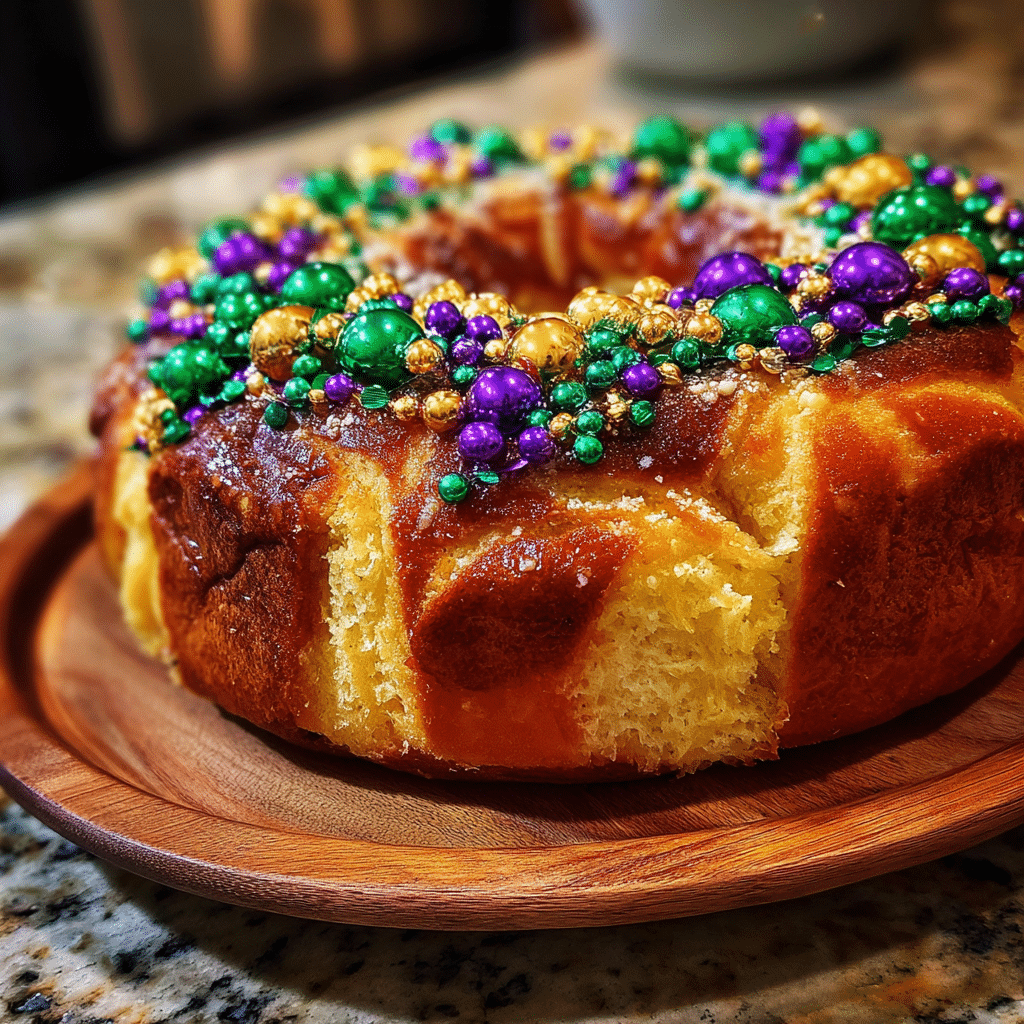
New Orleans King Cake recipe is the ultimate celebration bread that brings Mardi Gras magic to your kitchen. Are you tired of dry, dense king cakes that taste more like cardboard than the festive, buttery pastry they should be? Do you want to create an authentic New Orleans showstopper that rivals the legendary bakeries on Magazine Street but feel intimidated by yeast dough and braiding techniques? This foolproof recipe delivers a pillowy-soft, cinnamon-swirled masterpiece crowned with the iconic purple, green, and gold icing a cake so impressive your friends will think you flew it in from Louisiana.
Hi there, I’m Simon, and this New Orleans King Cake recipe holds a special place in my heart because it connects me to one of America’s most vibrant food traditions. Years ago, I visited New Orleans during Mardi Gras and tasted my first authentic king cake from a century-old French Quarter bakery I was hooked instantly. When I returned home, I was determined to recreate that experience with help from Megan Carter, my pastry genius. We spent weeks testing different dough formulas, filling ratios, and icing techniques until we nailed the perfect balance of buttery richness, cinnamon sweetness, and tender crumb. Olivia Brooks photographed every test batch, and even our “failures” looked gorgeous thanks to those festive colors. In this comprehensive guide, I’ll walk you through selecting the right ingredients for authentic flavor, mastering the enriched dough technique, creating the signature braided oval shape, and decorating with traditional Mardi Gras colors that’ll make your cake Instagram-worthy.
Why This New Orleans King Cake Recipe Works
This isn’t just another sweet bread recipe it’s a carefully developed formula that delivers authentic Louisiana flavor with techniques that actually work for home bakers.
- Uses simple ingredients you already have: Flour, butter, eggs, milk, and cinnamon create bakery-quality results without specialty items or expensive imports
- No-fail yeast dough with clear instructions: Detailed temperature guidance and visual cues ensure your dough rises perfectly every time, even if you’re a yeast-baking beginner
- Perfect for Mardi Gras celebrations or weekend baking: This showstopping cake feeds 12-16 people and becomes the centerpiece of any gathering
- Authentic New Orleans flavor without traveling to Louisiana: Capture the spirit of the French Quarter with traditional cinnamon-sugar filling and cream cheese icing
- Make-ahead friendly for stress-free entertaining: Prepare the dough the night before and bake fresh the next morning, or freeze the finished cake for up to a month
Choosing the Right Ingredients for New Orleans King Cake Recipe
The secret to an exceptional king cake starts with understanding your ingredients. Quality matters tremendously in enriched dough recipes like this one.
Best Flour for This Recipe
All-purpose flour is the foundation of this New Orleans King Cake recipe, and the right protein content makes all the difference. Look for flour with 10-12% protein (most national brands like King Arthur, Gold Medal, or Pillsbury fall in this range). This moderate protein level creates enough structure to support the rich dough while maintaining tenderness.
Bread flour (12-14% protein) can work but creates a chewier, more substantial texture that’s less true to authentic king cake. Save bread flour for bagels and artisan loaves. Cake flour is too delicate and won’t provide enough structure for the heavy filling and toppings.
For the most authentic texture, measure your flour correctly: spoon it into the measuring cup and level off with a knife rather than scooping directly from the bag, which packs in too much flour and creates dense, dry cake.
Best Butter and Dairy Components
Unsalted butter is crucial for this recipe—you need control over the salt level, and the sweet cream flavor of quality butter shines through in enriched doughs. European-style butter (like Kerrygold or Plugrá) with higher butterfat (82-84% versus American butter’s 80%) creates even more tender, flavorful results, though standard unsalted butter works beautifully.
Whole milk provides richness and helps create the tender crumb that makes king cake special. Don’t substitute low-fat or skim milk—the fat is essential for texture. For an even richer cake, replace half the milk with heavy cream.
Cream cheese in the icing is non-negotiable for authentic New Orleans flavor. Use full-fat brick cream cheese (Philadelphia is ideal), softened to room temperature for smooth, lump-free icing.
Best Yeast for King Cake Success
Active dry yeast or instant yeast both work perfectly in this New Orleans King Cake recipe. Instant yeast (also called rapid-rise or bread machine yeast) can be mixed directly into dry ingredients and rises slightly faster. Active dry yeast should be dissolved in warm liquid first (105-115°F) to activate it.
Check the expiration date on your yeast—old yeast won’t rise properly and will ruin your cake. To test yeast freshness, dissolve it in warm water with a pinch of sugar; it should foam vigorously within 5-10 minutes. If nothing happens, the yeast is dead and should be replaced.
Buying Tips
For butter, buy at least 1-2 weeks before the expiration date to ensure freshness. Store in the refrigerator or freeze for longer storage. When buying cream cheese, check that packages are firm, not soft or bulging, which indicates spoilage. For food coloring to achieve those vibrant Mardi Gras colors, gel or paste food coloring creates more saturated hues than liquid food coloring without thinning the icing.
Cinnamon quality matters: Ceylon cinnamon (also called “true cinnamon”) has a sweeter, more delicate flavor than the common Cassia cinnamon found in most grocery stores. Either works, but Ceylon elevates the filling to something special.
Substitutions
Dairy-free: Use plant-based butter (like Miyoko’s or Earth Balance) and full-fat coconut milk or oat milk in place of dairy milk. For dairy-free icing, use vegan cream cheese and plant-based butter.
Lower sugar: You can reduce the sugar in the dough by up to 25% without affecting texture significantly, though the cake will be less sweet. The icing sugar cannot be reduced much or it won’t set properly.
Gluten-free: This recipe doesn’t convert well to gluten-free flour. For gluten-free king cake, you’ll need a completely different formula designed for GF baking.
Ingredients & Prep for New Orleans King Cake Recipe

Organization is absolutely critical with yeast dough. Having everything measured, at the right temperature, and ready to go ensures success and reduces stress.
Dough Ingredients
For the Enriched Dough (makes 1 large king cake):
- 4 cups (500g) all-purpose flour, plus more for dusting
- ⅓ cup (67g) granulated sugar
- 2¼ teaspoons (7g or 1 packet) active dry yeast or instant yeast
- 1 teaspoon salt
- ½ teaspoon ground nutmeg
- Zest of 1 lemon (about 1 tablespoon)
- ¾ cup (180ml) whole milk, warmed to 110°F
- 3 large eggs, room temperature
- 6 tablespoons (85g) unsalted butter, softened to room temperature
- 1 teaspoon vanilla extract
For the Cinnamon Filling:
- ½ cup (100g) light brown sugar, packed
- 2 tablespoons ground cinnamon
- 3 tablespoons unsalted butter, melted
For the Cream Cheese Icing:
- 4 ounces cream cheese, softened
- 2 tablespoons unsalted butter, softened
- 2 cups (240g) powdered sugar
- 2-3 tablespoons milk or heavy cream
- 1 teaspoon vanilla extract
- Purple, green, and gold food coloring
For Decoration:
- Colored sanding sugar in purple, green, and gold (traditional Mardi Gras colors)
- 1 small plastic baby (traditional king cake baby, optional)
Dough Preparation Essentials
The key to perfect enriched dough is temperature control. All ingredients should be at room temperature (68-72°F) except the milk, which should be warmed to 110°F—warm enough to activate yeast but not so hot it kills it (anything over 120°F kills yeast).
To quickly bring eggs to room temperature, place them in a bowl of warm (not hot) water for 5-10 minutes. To soften butter properly, cut it into tablespoon-sized pieces and let sit at room temperature for 30-45 minutes—it should be soft enough to leave a fingerprint but not greasy or melting.
Warm the milk gently in the microwave (30-second intervals, stirring between) or on the stovetop over low heat. Use an instant-read thermometer to verify temperature—this is one of the most common failure points in yeast baking.
Timing and Planning
This New Orleans King Cake recipe requires time for rising, so plan accordingly. Total time from start to finish is about 4-5 hours, but most of that is hands-off rising time. Here’s a realistic timeline:
- Mixing and kneading: 15-20 minutes
- First rise: 1.5-2 hours
- Shaping and filling: 15 minutes
- Second rise: 45-60 minutes
- Baking: 25-30 minutes
- Cooling and decorating: 30 minutes
For make-ahead convenience, you can prepare the dough through the first rise, punch it down, cover tightly, and refrigerate overnight. The next morning, bring it to room temperature (about 1 hour), then proceed with shaping and the second rise.
Step-by-Step Baking Instructions for New Orleans King Cake Recipe

Let me walk you through every stage of creating this iconic cake. Megan taught me that success with enriched dough comes from patience and attention to detail.
Pre-Baking Prep for New Orleans King Cake Recipe
Before you begin mixing, prepare your workspace. You’ll need a large mixing bowl (or stand mixer bowl), a clean work surface for kneading, and a warm, draft-free spot for rising. The ideal rising temperature is 75-80°F—if your kitchen is cold, turn on your oven for 1 minute, turn it off, and use it as a proofing box.
Gather all your ingredients and bring them to the proper temperatures as described above. Measure your flour correctly (spoon and level method) and have all other ingredients ready to go. Line a large baking sheet with parchment paper or a silicone mat for later.
Mixing and Kneading Method for New Orleans King Cake Recipe
Step 1: Activate the Yeast (if using active dry yeast) If using active dry yeast, combine the warm milk (110°F) and 1 teaspoon of the sugar in a small bowl. Sprinkle the yeast over the top and let sit for 5-10 minutes until foamy. If using instant yeast, skip this step and add it directly to the dry ingredients.
Step 2: Mix the Dough In a large bowl or stand mixer fitted with the dough hook, whisk together flour, remaining sugar, salt, nutmeg, and lemon zest. If using instant yeast, whisk it in with the dry ingredients.
Add the warm yeast mixture (or warm milk if using instant yeast), eggs, softened butter, and vanilla extract. Mix on low speed (or stir with a wooden spoon) until a shaggy dough forms.
Step 3: Knead the Dough If using a stand mixer, knead on medium-low speed for 8-10 minutes until the dough is smooth, elastic, and slightly tacky but not sticky. It should pull away from the sides of the bowl and feel soft and supple when poked.
If kneading by hand, turn the dough onto a lightly floured surface and knead for 10-12 minutes. The dough will be sticky at first—resist the urge to add too much flour. Use a bench scraper to help manipulate the dough and add flour sparingly, just enough to prevent sticking.
The windowpane test: Tear off a small piece of dough and gently stretch it between your fingers. If it stretches thin enough to see light through it without tearing, the gluten is properly developed. If it tears immediately, knead for another 2-3 minutes.
First Rise for New Orleans King Cake Recipe
Form the kneaded dough into a smooth ball and place it in a lightly greased large bowl, turning once to coat all sides with oil (this prevents a dry skin from forming). Cover the bowl tightly with plastic wrap or a damp kitchen towel.
Place in your warm, draft-free spot and let rise for 1.5-2 hours, until doubled in size. To test if it’s ready, gently press two fingers into the dough—if the indentations remain and don’t spring back, the dough is properly risen.
Shaping and Filling New Orleans King Cake Recipe
Step 1: Roll Out the Dough Once the dough has doubled, punch it down gently to release air bubbles. Turn it out onto a lightly floured surface and roll it into a large rectangle, approximately 24 inches long by 12 inches wide and about ½ inch thick. The exact dimensions aren’t critical, but aim for an even thickness throughout.
Step 2: Add the Filling Brush the melted butter evenly over the entire surface of the dough, leaving a ½-inch border along one long edge (this will be your seam). In a small bowl, mix together brown sugar and cinnamon. Sprinkle the cinnamon-sugar mixture evenly over the buttered dough.
Step 3: Roll and Shape Starting from the long edge opposite the bare border, tightly roll the dough into a long log, like making cinnamon rolls. Pinch the seam closed and place the log seam-side down.
Carefully transfer the log to your prepared baking sheet. Bring the two ends together to form an oval ring (the traditional king cake shape), pinching the ends together firmly to seal. You can also braid three ropes of filled dough for a more decorative appearance, though the simple oval is traditional and easier.
If desired, insert the plastic baby into the bottom of the cake from the underside—tradition says whoever gets the baby in their slice must host next year’s Mardi Gras party or bring the next king cake.
Second Rise and Baking for New Orleans King Cake Recipe
Cover the shaped cake loosely with plastic wrap or a clean kitchen towel. Let rise in a warm spot for 45-60 minutes, until puffy and nearly doubled again. It should look pillowy and spring back slowly when gently poked.
Preheat your oven to 350°F (175°C) during the last 15 minutes of the second rise.
Bake for 25-30 minutes, until the top is golden brown and the internal temperature reaches 190°F when tested with an instant-read thermometer. If the cake is browning too quickly, tent it loosely with aluminum foil during the last 10 minutes of baking.
Remove from the oven and let cool on the baking sheet for 10 minutes, then carefully transfer to a wire cooling rack. Let cool completely before icing—icing on a warm cake will melt and run off.
Icing and Decorating New Orleans King Cake Recipe
Step 1: Make the Cream Cheese Icing In a medium bowl, beat softened cream cheese and butter together with an electric mixer until smooth and creamy. Add powdered sugar, milk (starting with 2 tablespoons), and vanilla extract. Beat until smooth and spreadable—add more milk if needed to reach desired consistency. The icing should be thick enough to hold its shape but pourable.
Step 2: Divide and Color Divide the icing into three separate bowls. Color one portion purple, one green, and one gold using gel or paste food coloring. Traditional Mardi Gras colors represent justice (purple), faith (green), and power (gold).
Step 3: Decorate Starting with one color, drizzle or spread the icing over one-third of the cooled cake. Immediately sprinkle with coordinating colored sanding sugar before the icing sets. Repeat with the second and third colors, creating distinct purple, green, and gold sections around the ring. The colors should alternate for maximum visual impact.
Let the icing set for at least 20 minutes before slicing and serving.
Pro Tips for Perfect New Orleans King Cake Recipe
After making dozens of king cakes and troubleshooting every possible issue, here are the insider secrets that guarantee success.
Avoiding Dense or Dry New Orleans King Cake Recipe
Don’t add too much flour: This is the number one mistake in yeast baking. The dough should be soft and slightly tacky, not stiff. If you’ve added too much flour during kneading, the cake will be dense and dry.
Proof in a warm environment: Yeast needs warmth to work properly. If your kitchen is cold (below 70°F), your dough will take much longer to rise or may not rise adequately. Use the warm oven trick or place the bowl near (not on) a radiator or heating vent.
Don’t overbake: King cake continues cooking for a few minutes after you remove it from the oven (carryover cooking). Pull it when it’s just golden and reaches 190°F internally—overbaking creates dry, tough cake.
Measure accurately: Use a kitchen scale for the most precise measurements, especially for flour. Volume measurements can vary by 20-30% depending on how you scoop.
Don’t skip the butter: The high butter content is what makes king cake tender and rich. Low-fat versions won’t have the right texture or flavor.
Tool Recommendations for New Orleans King Cake Recipe
A stand mixer with dough hook makes kneading effortless and develops gluten more consistently than hand-kneading, though hand-kneading absolutely works with patience. An instant-read thermometer takes the guesswork out of milk temperature (for yeast activation) and doneness. A bench scraper is invaluable for handling sticky dough and dividing it cleanly. Gel or paste food coloring creates vivid Mardi Gras colors that liquid coloring can’t match.
A rolling pin creates even dough thickness for consistent baking. Parchment paper prevents sticking and makes transferring the delicate shaped cake easier. A large baking sheet (half-sheet pan, 18×13 inches) accommodates the full oval shape comfortably.
Storage & Reheating for New Orleans King Cake Recipe
Room temperature storage: Keep king cake in an airtight container or wrapped tightly in plastic wrap at room temperature for up to 3 days. The cake stays moister at room temperature than refrigerated.
Refrigerator storage: If your kitchen is very warm (above 75°F), refrigerate the cake to prevent the cream cheese icing from spoiling. Bring to room temperature before serving for best flavor and texture.
Freezing: Wrap the cooled, un-iced cake tightly in plastic wrap, then aluminum foil, and freeze for up to 2 months. Thaw overnight at room temperature, then ice and decorate as directed. You can also freeze the fully decorated cake, though the icing may become slightly grainy when thawed.
Reheating: Warm individual slices in the microwave for 10-15 seconds or in a 300°F oven for 5-7 minutes to restore that fresh-baked softness.
Flavor Variations for New Orleans King Cake Recipe
Once you’ve mastered the traditional version, these variations offer new ways to enjoy this Mardi Gras classic.
Cream Cheese Filled New Orleans King Cake Recipe
Create a cream cheese filling by beating together 8 ounces softened cream cheese, ¼ cup sugar, 1 egg yolk, and 1 teaspoon vanilla until smooth. Spread the cinnamon-sugar filling on the rolled dough as directed, then spread the cream cheese mixture on top before rolling. The result is incredibly rich with tangy cream cheese ribbons throughout.
Praline New Orleans King Cake Recipe
Mix ½ cup chopped pecans into the cinnamon-sugar filling for nutty crunch and authentic New Orleans flavor. For extra decadence, drizzle the finished cake with praline sauce made from brown sugar, butter, and cream before adding the colored icing.
Fruit-Filled New Orleans King Cake Recipe
Spread ½ cup of fruit preserves (cherry, strawberry, or blueberry are traditional choices) over the cinnamon-sugar filling before rolling. The fruit adds moisture and a pop of flavor that complements the sweet dough beautifully.
Variation Comparison Table
| Variation | Filling Addition | Special Technique | Flavor Profile | Complexity Level |
|---|---|---|---|---|
| Traditional Cinnamon | Cinnamon-sugar only | Standard rolling | Classic, sweet, spiced | Easy |
| Cream Cheese Filled | Cream cheese mixture + cinnamon | Layer both fillings | Rich, tangy, decadent | Medium |
| Praline | Chopped pecans + cinnamon-sugar | Add nuts to filling | Nutty, authentic NOLA | Easy |
| Fruit-Filled | Fruit preserves + cinnamon | Spread preserves evenly | Fruity, moist, sweet | Easy |
| Chocolate Chip | Mini chocolate chips + cinnamon | Sprinkle chips on filling | Sweet, indulgent, kid-friendly | Easy |
| King Cake Bread Pudding | Use day-old king cake | Cube and bake with custard | Ultra-rich, dessert-worthy | Medium |
Serving Suggestions for New Orleans King Cake Recipe
This festive cake deserves to be served with style. Here’s how to make the most of your New Orleans creation.
For Mardi Gras parties: Serve king cake as the centerpiece dessert, surrounded by Mardi Gras beads, masks, and doubloons for authentic Louisiana atmosphere. Explain the tradition of the hidden baby and crown the lucky finder “king” or “queen” for the day.
For breakfast or brunch: King cake is traditionally eaten for breakfast during Carnival season. Serve warm slices with strong coffee or café au lait (equal parts coffee and steamed milk) for an authentic New Orleans breakfast experience.
For celebrations beyond Mardi Gras: While king cake is associated with Mardi Gras, it’s delicious any time you want a festive sweet bread. Skip the plastic baby and traditional colors for birthday parties, potlucks, or weekend baking projects.
Portion sizes: Cut the cake into 12-16 slices, depending on size. Slices are rich, so smaller portions are appropriate, especially if serving alongside other desserts.
Beverage pairings: Hot coffee (especially dark roast or chicory coffee like Café Du Monde), hot chocolate, or milk for children. For adults, champagne or sparkling beverages pair beautifully with the sweet, buttery cake for special celebrations.
Make it interactive: Let guests decorate their own slices with extra icing and colored sugars at the table—kids especially love this activity.
FAQs About New Orleans King Cake Recipe
Over the years, I’ve answered countless questions about king cake baking. Here are the most common concerns and solutions.
Can I make this dough in a bread machine?
Yes! Add ingredients to the bread machine in the order recommended by your machine’s manual (usually liquids first, then dry ingredients, then yeast on top). Use the dough cycle, which will mix, knead, and complete the first rise. Then remove the dough, shape, fill, and proceed with the second rise and baking as directed.
What if my dough doesn’t rise?
Check these common issues: dead yeast (test it first), liquid too hot or too cold (must be 105-115°F for active dry yeast), too much flour making the dough stiff, or a too-cold environment. If your dough hasn’t risen after 2 hours, start over with fresh yeast.
Can I make king cake without the plastic baby?
Absolutely! The plastic baby is traditional but optional. Many bakeries now place it on top of the cake or include it separately due to choking hazard concerns. You can also use a dried bean, pecan half, or small coin wrapped in foil as the hidden surprise.
Is this New Orleans King Cake recipe safe during pregnancy?
Yes, when properly baked. The eggs and dairy are fully cooked during baking (internal temperature reaches 190°F, well above the 160°F needed for food safety). Use pasteurized dairy products and fresh eggs for maximum safety.
Why is my king cake dense instead of fluffy?
Dense king cake usually results from: too much flour, under-kneading (gluten not properly developed), insufficient rising time, or old yeast. Make sure to measure flour correctly, knead until you can pass the windowpane test, and give adequate time for both rises.
Can I make mini king cakes?
Yes! Divide the dough into 4-6 portions after the first rise. Roll each into a smaller rectangle, fill, roll, and shape into individual rings. Reduce baking time to 15-20 minutes and watch carefully for golden brown color.
What makes New Orleans king cake different from other king cakes?
New Orleans-style king cake is typically a brioche-style sweet bread with cinnamon filling and cream cheese icing in Mardi Gras colors. French galette des rois is a puff pastry with almond cream filling. Mexican rosca de reyes is similar to New Orleans style but often includes dried fruits and has different decorations.
How do I know when the cake is done baking?
The cake should be deeply golden brown on top, sound hollow when tapped on the bottom, and register 190°F on an instant-read thermometer inserted into the thickest part of the cake (avoid hitting the filling, which will give a false reading).
Conclusion
New Orleans King Cake recipe brings the magic of Mardi Gras into your home kitchen with a showstopping pastry that’s surprisingly achievable for bakers of all skill levels. This soft, buttery, cinnamon-swirled masterpiece crowned with festive purple, green, and gold icing proves that you don’t need to fly to New Orleans to experience authentic Carnival season treats.
Print
New Orleans King Cake Recipe 9 Secrets to Authentic Perfection
- Total Time: 4 hours 30 minutes (includes rising time)
- Yield: 12–16 servings 1x
- Diet: Vegetarian
Description
Authentic New Orleans King Cake with soft, buttery brioche-style dough, sweet cinnamon filling, and traditional cream cheese icing in Mardi Gras colors of purple, green, and gold. This showstopping celebration bread is perfect for Carnival season or any festive occasion.
Ingredients
For the Enriched Dough:
4 cups (500g) all-purpose flour, plus more for dusting
⅓ cup (67g) granulated sugar
2¼ teaspoons (7g or 1 packet) active dry yeast or instant yeast
1 teaspoon salt
½ teaspoon ground nutmeg
Zest of 1 lemon (about 1 tablespoon)
¾ cup (180ml) whole milk, warmed to 110°F
3 large eggs, room temperature
6 tablespoons (85g) unsalted butter, softened
1 teaspoon vanilla extract
For the Cinnamon Filling:
½ cup (100g) light brown sugar, packed
2 tablespoons ground cinnamon
3 tablespoons unsalted butter, melted
For the Cream Cheese Icing:
4 ounces cream cheese, softened
2 tablespoons unsalted butter, softened
2 cups (240g) powdered sugar
2–3 tablespoons milk or heavy cream
1 teaspoon vanilla extract
Purple, green, and gold food coloring (gel or paste recommended)
For Decoration:
Colored sanding sugar in purple, green, and gold
1 small plastic baby (optional, traditional)
Instructions
1. If using active dry yeast: Combine warm milk (110°F) and 1 teaspoon sugar in a small bowl. Sprinkle yeast over top and let sit 5-10 minutes until foamy.
2. In a large bowl or stand mixer, whisk together flour, remaining sugar, salt, nutmeg, and lemon zest. If using instant yeast, add it now.
3. Add yeast mixture (or warm milk if using instant yeast), eggs, softened butter, and vanilla. Mix on low speed until shaggy dough forms.
4. Knead with dough hook on medium-low for 8-10 minutes (or by hand for 10-12 minutes) until smooth, elastic, and slightly tacky. Dough should pass windowpane test.
5. Form dough into a ball and place in lightly greased bowl, turning to coat. Cover with plastic wrap.
6. Let rise in warm spot (75-80°F) for 1.5-2 hours until doubled in size.
7. Punch down dough and turn onto lightly floured surface. Roll into 24×12-inch rectangle, about ½-inch thick.
8. Brush melted butter over dough, leaving ½-inch border on one long edge.
9. Mix brown sugar and cinnamon; sprinkle evenly over buttered dough.
10. Starting from long edge opposite the border, tightly roll dough into a log. Pinch seam closed.
11. Transfer to parchment-lined baking sheet. Bring ends together to form oval ring, pinching ends to seal.
12. Cover loosely and let rise 45-60 minutes until puffy and nearly doubled.
13. Preheat oven to 350°F (175°C) during last 15 minutes of rise.
14. Bake 25-30 minutes until golden brown and internal temperature reaches 190°F. Tent with foil if browning too quickly.
15. Cool on baking sheet 10 minutes, then transfer to wire rack and cool completely.
16. Make icing: Beat cream cheese and butter until smooth. Add powdered sugar, 2 tablespoons milk, and vanilla; beat until spreadable. Add more milk if needed.
17. Divide icing into 3 bowls. Color one purple, one green, one gold using food coloring.
18. Drizzle or spread each colored icing over one-third of cooled cake. Immediately sprinkle with coordinating colored sugar.
19. Let icing set 20 minutes before serving.
Notes
All ingredients should be at room temperature except milk (warmed to 110°F).
Dough can be prepared through first rise, punched down, and refrigerated overnight. Bring to room temperature before shaping.
Don’t add too much flour—dough should be soft and slightly tacky.
For braided version, divide filled dough into 3 ropes and braid before forming ring.
Insert plastic baby from bottom of cooled cake if using (tradition says finder hosts next year’s party).
Store at room temperature in airtight container for up to 3 days.
Freeze un-iced cake wrapped tightly for up to 2 months. Thaw and ice before serving.
Warm slices in microwave for 10-15 seconds to restore fresh-baked texture.
Gel or paste food coloring creates more vibrant Mardi Gras colors than liquid.
- Prep Time: 30 minutes
- Cook Time: 30 minutes
- Category: Dessert, Breakfast, Bread
- Method: Baking, Yeast Bread
- Cuisine: American, New Orleans, Cajun
Nutrition
- Serving Size: 1 slice
- Calories: 310
- Sugar: 24g
- Sodium: 180mg
- Fat: 11g
- Saturated Fat: 6g
- Unsaturated Fat: 4g
- Trans Fat: 0g
- Carbohydrates: 48g
- Fiber: 1g
- Protein: 6g
- Cholesterol: 65mg
Keywords: king cake, new orleans king cake, mardi gras cake, carnival cake, brioche, cinnamon bread, celebration bread, yeast bread